
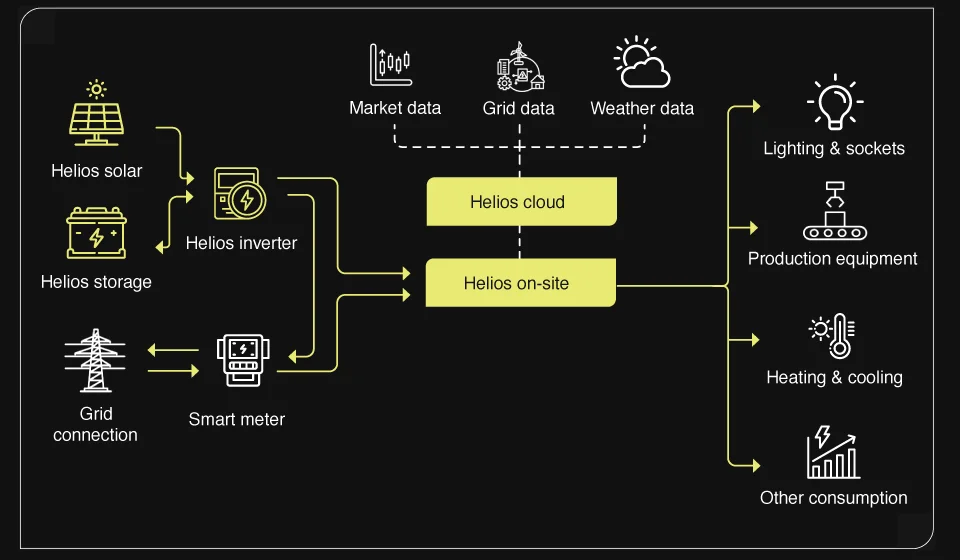
Already having a business management system in place is a common assumption — especially in facilities management — that energy requirements are covered. It can also be one of the most expensive, simply because a building management system and energy management software are built to do different jobs.
What a BMS Actually Does
A building management system controls the physical equipment in a building. It runs the schedules, manages setpoints, sequences, and responds to sensors in real time to keep heating, cooling, lighting, and ventilation working. Its job is to execute what it’s been told.
It’s a useful and important function but also narrower than most people assume. A BMS doesn’t ask whether what it’s been told to do is the right thing. It doesn’t compare a site’s energy consumption against what it should be using. It doesn’t flag that a schedule someone set two years ago no longer matches how the building is used.
What Energy Management Software Does Instead
Energy management software sits above that layer and asks different questions. Is this site consuming what it should be, given its size, use, and conditions? Is a piece of equipment behaving in a way that suggests a fault? Where is the consumption that doesn’t match the pattern it should?
This is an analysis and insight layer. It doesn’t run the site — it interprets what’s going on, compares it against expectation, and surfaces where and why something has gone off track.
Why Having One Doesn’t Mean You Have The Other
The confusion is understandable, because both systems deal with the same underlying data — temperature, runtime, consumption. But a BMS reading that data is not the same as a system reading that data to assess whether the schedule is still right.
A site can have a fully functioning, well-maintained BMS and still be wasting energy — because the BMS is doing exactly what it’s configured to do, and nobody has checked whether it still makes sense. Setpoints get adjusted for a one-off complaint and never revisited. Schedules get built around a shift pattern that’s since changed. None of this shows up as a BMS fault, because nothing has actually failed. The system is running correctly but it’s just running the wrong instructions.
Where The Two Work Together
The strongest setup isn’t a choice — it’s both. The BMS keeps the building running to instruction, reliably and in real time. Energy management software checks whether that instruction is still the right one, spots an anomaly a BMS has no way of noticing, and flags it before it becomes a pattern.
Without that second layer, a well-run BMS just means waste happens very consistently.
A BMS tells you if the building’s doing what it’s been told. Energy management software tells you if what it’s been told is still correct.
If a site’s BMS hasn’t been reviewed against usage patterns in a while, that’s usually where the gap starts to show.